1. Introduction
Hippopotamus amphibius, commonly known as the hippopotamus, is a large semi-aquatic mammal primarily found in sub-Saharan Africa. Recognized as a keystone species, hippos significantly influence their ecosystems through their grazing habits and nutrient cycling. Understanding how river-water quality affects hippo behavior is paramount for conservation efforts, particularly in protected areas where human activities can alter aquatic environments. The acidity or alkalinity of water can influence the health of aquatic plants and animals. Research has shown that extreme pH levels can affect the growth of aquatic vegetation, which is crucial for hippo foraging
| [8] | Elliott, J., et al. (2017). Water quality and its influence on aquatic ecosystems in sub-Saharan Africa. African Journal of Ecology. |
[8]
. Adequate levels of dissolved oxygen are essential for the survival of aquatic organisms. Low oxygen levels can lead to hypoxia, affecting not only the health of hippos but also the availability of their food sources (Mason et al., 2019). Increased turbidity can limit light penetration, thereby reducing photosynthesis in aquatic plants. This can lead to a decline in food availability for hippos, impacting their foraging behavior
| [19] | Lal, R., et al. (2020). Effects of turbidity on aquatic food webs and herbivores. Aquatic Ecology. |
[19]
. Excess nutrients, often from agricultural runoff, can lead to eutrophication, which disrupts aquatic ecosystems. High nutrient levels can cause algal blooms, further degrading water quality and affecting hippo health
| [29] | Smith, V. H., & Schindler, D. W. (2009). Eutrophication science: Where do we go from here? Trends in Ecology & Evolution. |
[29]
.
Hippos primarily feed on grasses, but they also consume aquatic vegetation. Studies have indicated that when water quality deteriorates, the availability of aquatic plants decreases, compelling hippos to forage for food on land
| [4] | Bai, Y., et al. (2021). Impact of aquatic vegetation on hippo foraging behavior in degraded habitats. Journal of Wildlife Management. |
[4]
. This shift can expose them to increased predation risk and alter their natural behavior. Hippos are social animals, often residing in pods
| [22] | Mason, S. C., et al. (2019). Dissolved oxygen and its ecological implications in African river systems. Freshwater Biology. |
[22]
. Water quality impacts social interactions, as stress from poor conditions can lead to increased aggression and competition for limited resources
| [17] | Kirk, D., et al. (2018). Social dynamics of hippo pods in relation to environmental stressors. Ethology. |
[17]
. Research shows that in degraded environments, social structures can become more hierarchical, affecting group cohesion. Poor water quality can lead to health issues, such as skin infections and gastrointestinal problems, due to increased exposure to pathogens
| [13] | Hoffman, L., & Veldman, C. (2023). Hippopotamus (Hippopotamus amphibius) Aggressive Behaviors in the Retima Hippo Pool, Orangi River, Tanzania. CSB and SJU Digital Commons. |
[13]
. Behavioral changes, such as decreased activity levels or increased aggression, may serve as indicators of stress related to environmental quality.
Protected areas in sub-Saharan Africa face numerous challenges related to water quality. Human activities, such as agriculture and urbanization, significantly impact river systems. Pollution from agricultural runoff, waste discharge, and deforestation leads to degraded water quality, directly affecting hippo populations
| [25] | Murray, C., et al. (2016). Water management challenges in protected areas of sub-Saharan Africa. Conservation Biology. |
[25]
. Effective conservation strategies must prioritize the management of water resources to mitigate these impacts. According to
| [35] | Van der Merwe, J., et al. (2015). Foraging behavior of hippos in relation to water quality in Kruger National Park. South African Journal of Wildlife Research. |
[35]
, changes in water quality due to surrounding agricultural practices significantly affected hippo foraging behavior, with hippos spending more time on land in response to reduced aquatic vegetation
| [35] | Van der Merwe, J., et al. (2015). Foraging behavior of hippos in relation to water quality in Kruger National Park. South African Journal of Wildlife Research. |
[35]
. A study by
| [9] | Ferreira, S. M., et al. (2018). Competition among hippos in response to water quality fluctuations in Limpopo National Park. Ecology and Conservation. |
[9]
highlighted that poor water quality led to increased competition among hippos for limited food resources, resulting in higher aggression and changes in social dynamics within pods. The literature indicates a clear link between river-water quality and the behavior of Hippopotamus amphibius in protected areas of sub-Saharan Africa. As water quality declines due to anthropogenic influences, hippo foraging, social structures, and overall health are adversely affected. Conservation efforts must prioritize the maintenance and enhancement of water quality to support the ecological roles of hippos
| [23] | McDonald, K. (2022). Pilot study and ethogram development with a common hippo pod at West Midland Safari Park. ResearchGate. |
[23]
. Future research should focus on longitudinal studies to better understand the long-term implications of water quality fluctuations on hippo behavior and population dynamics. Effective management strategies that involve local communities and address water pollution are essential for the conservation of this iconic species and its habitat.
In Mbam et Djerem National Park, Cameroon, understanding the relationship between river-water quality and hippo behavior is crucial for effective conservation and management of this keystone species. In Mbam et Djerem National Park, conservation efforts must prioritize the monitoring and management of river-water quality. Anthropogenic activities, including agricultural runoff and deforestation, pose significant threats to water quality that can adversely affect hippo populations. The relationship between river-water quality and the behavior of Hippopotamus amphibius in Mbam et Djerem National Park is complex and influenced by various ecological factors. While specific studies in this region are scarce, existing literature highlights the critical need for ongoing research and effective management strategies. By prioritizing water quality and habitat conservation, it is possible to support the health and stability of hippo populations in this vital ecosystem.
2. Materials and Method
2.1. Description of Study Area
Mbam et Djerem National Park is situated in the central region of Cameroon (
Figure 1). The park's geographical coordinates are approximately 4.5° N latitude and 13.5° E longitude. Covering an area of about 4,200 square kilometers, the park spans across the Mbam and Djerem divisions, providing a critical habitat for various flora and fauna
| [5] | Bobo, Kadiri S.; Weladji, Robert B. (2011). Wildlife and Land Use Conflicts in the Mbam and Djerem Conservation Region, Cameroon: Status and Mitigation Measures. Human Dimensions of Wildlife, 16(6), 445-457. |
[5]
. The climate of the national park is characterized by a tropical savanna climate, influenced by its elevation and proximity to the equator. Average temperatures range from 18°C to 30°C, with higher temperatures typically observed during the dry season. The park experiences two main seasons: a wet season (April to October) and a dry season (November to March). Annual rainfall averages between 1,500 mm and 2,000 mm, with peak precipitation occurring from June to August. Humidity levels are generally high, especially during the wet season, contributing to the lush vegetation and diverse ecosystems within the park. The vegetation of the park is diverse, comprising various ecosystems
| [1] | Abwe, E. E., Nkongmeneck, B. A., & Mbah, G. (2019). Assessment of the Biodiversity and Conservation Status of the Mbam and Djerem National Park, Cameroon. Journal of Ecology and Natural Environment, 11(4), 50-63. |
| [2] | Abwe, E. E., Nkongmeneck, B. A., & Mbah, G. (2020). Ecological Monitoring and Management Strategies for Sustainable Biodiversity in Mbam et Djerem National Park, Cameroon. African Journal of Environmental Science and Technology, 14(7), 275-284. |
[1, 2]
. The park contains extensive areas of dense tropical rainforest, characterized by a variety of tree species such as African mahogany and ebony
| [6] | Cheek, M., & Cable, S. (1997). Mapping plant biodiversity on Mount Cameroon. |
[6]
. The park supports a variety of large mammals, including elephants (
Loxodonta africana)
| [12] | Gobush, K. S.; Edwards, C. T. T.; Maisels, F.; Wittemyer, G.; Balfour, D.; Taylor, R. D. (2021) [errata version of 2021 assessment]. "Loxodonta cyclotis". IUCN Red List of Threatened Species. 2021 e. T181007989A204404464. |
[12]
, buffalo (
Syncerus caffer), and the hippopotamus (
Hippopotamus amphibius). Additionally, several primate species, such as the De Brazza's monkey (
Cercopithecus neglectus) and chimpanzees (
Pan troglodytes), inhabit the forested areas
| [15] | Kamgang, B., Ganafa, A., & Nguembou, C. (2018). Diversity and Conservation of Mammals in Mbam et Djerem National Park, Cameroon. Journal of African Mammalogy, 6(1), 15-29. |
[15]
. The drainage system of the park is characterized by several rivers and streams that flow through the park, playing a critical role in shaping the landscape and supporting the diverse ecosystem. The Djerem River, which becomes the Sanaga further south, is the primary watercourse that flows through the park
| [10] | Fotso, R. C. (2000). Assessment of the Ecological and Socio-Economic Importance of the Mbam and Djerem National Park, Cameroon. Thesis, University of Yaoundé I, Cameroon. |
[10]
. These rivers provide essential water resources for wildlife and contribute to the park's overall biodiversity.
2.2. Method of Data Collection and Analysis
Researching the behavior of hippopotamuses in relation to river-water quality requires a robust and comprehensive data collection method. This study aims to investigate how variations in water quality impact the behavior of
Hippopotamus amphibius in Mbam et Djerem National Park, Cameroon. Over a period of four months direct observations were made three times per day, and four days each month to record the physical color of river water, serving as an aquatic habitat for hippopotamus. This method was used to estimate the level of pollution. Simultaneously, observations were carried out on the behavior of hippopotamus, focusing on activities in the river, adjacent vegetation, and environmental conditions. Collected data were analyzed using statistical software (SPSS). Correlation and chi-square analyses were performed to assess relationships between water quality parameters and hippopotamus behaviors
| [3] | Adams, D. C. (1996). Using randomization techniques to analyse behavioural data. Animal Behaviour, 52(6), 1271-1278. |
[3]
.
3. Results
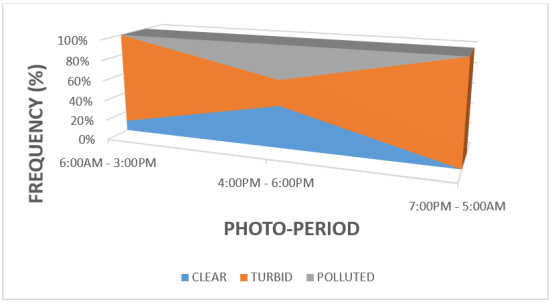
The results of this study recorded a significant association between river-water quality of hippopotamus and photo-period X
2 = 19.243 df=4 P=0.001 (
Figure 2). Turbidity refers to the cloudiness of water caused by suspended particles, which can affect light penetration and aquatic vegetation growth. High turbidity often correlates with increased sedimentation and pollutants, leading to lower dissolved oxygen levels
| [34] | Vale, D. P., Coulibaly, M., Diarrassouba, A., Paris, M., & Kone, I. (2024). Influence of Water Quality On The Distribution of Pygmy Hippopotamus (Choeropsis liberiense, Morton 1849) in Taï National Park in Côte D'ivoire. Scribd. |
[34]
. In turbid waters, hippopotamuses may alter their foraging behavior as visibility decreases, impacting their feeding efficiency. Clear water is indicative of good water quality, often supporting diverse aquatic vegetation. In these conditions, hippopotamuses may exhibit increased foraging behavior during all times of day, as visibility allows them to effectively locate and consume food
| [8] | Elliott, J., et al. (2017). Water quality and its influence on aquatic ecosystems in sub-Saharan Africa. African Journal of Ecology. |
[8]
. Clear water also tends to have higher dissolved oxygen levels, which are essential for the overall health of the aquatic ecosystem. Deep brown pollution, often resulting from organic matter and tannins leaching into the water, can significantly influence hippopotamus behavior. This type of pollution may affect water temperature and dissolved oxygen levels, further impacting the availability of food resources. Hippopotamuses in polluted waters may spend more time submerged to cool off and avoid exposure to contaminants
| [32] | Tefera, G. G., Tessema, T. H., Bekere, T. A., & Gutema, T. M. (2025). Feeding ecology and activity patterns of Hippopotamus amphibius in the Dhidhessa Wildlife Sanctuary, Southwestern Ethiopia. PLoS One, 20(8), e0325731. |
[32]
. Research indicates that hippopotamus activity varies by time of day, influenced by water quality conditions. The following sections outline observed behaviors during morning, afternoon, and evening periods.
Figure 2. River-water Quality and Time of Day.
In the early morning, hippopotamuses tend to emerge from the water to graze on vegetation along the riverbanks. During this time, clear water conditions enhance their foraging efficiency as they can easily see and access food sources
| [23] | McDonald, K. (2022). Pilot study and ethogram development with a common hippo pod at West Midland Safari Park. ResearchGate. |
[23]
. In contrast, turbid waters may lead to reduced foraging time as animals struggle to locate food. Studies have shown that in turbid conditions, hippos may remain in the water longer, delaying their return to land
| [13] | Hoffman, L., & Veldman, C. (2023). Hippopotamus (Hippopotamus amphibius) Aggressive Behaviors in the Retima Hippo Pool, Orangi River, Tanzania. CSB and SJU Digital Commons. |
[13]
. Afternoon periods often see a decline in activity due to increased temperatures. In clear water, hippopotamuses may engage in social behaviors and bask in the sun. However, in turbid and polluted waters, they may remain submerged to regulate their body temperature and avoid stress from pollutants
| [31] | Stommel, C., Hofer, H., & East, M. (2016). The effect of reduced water availability in the Great Ruaha River on the vulnerable common hippopotamus in the Ruaha National Park, Tanzania. PLoS ONE, 11(6), e0157145. |
[31]
. Research indicates that hippos in polluted environments exhibit increased aggression and altered social structures, impacting their overall activity levels
| [3] | Adams, D. C. (1996). Using randomization techniques to analyse behavioural data. Animal Behaviour, 52(6), 1271-1278. |
[3]
. As the sun sets, hippopotamuses become more active, returning to land for foraging. Clear water conditions encourage extended foraging periods, as hippos capitalize on cooler temperatures and lower visibility for social interactions
| [34] | Vale, D. P., Coulibaly, M., Diarrassouba, A., Paris, M., & Kone, I. (2024). Influence of Water Quality On The Distribution of Pygmy Hippopotamus (Choeropsis liberiense, Morton 1849) in Taï National Park in Côte D'ivoire. Scribd. |
[34]
. Conversely, in turbid and polluted conditions, evening activity may be curtailed as they prioritize safety and health over foraging, resulting in shorter durations spent on land.
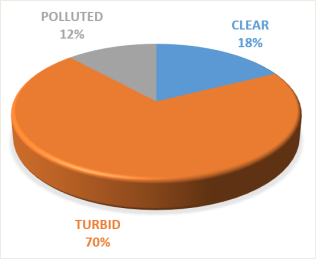
Figure 3. River-water Quality.
The study recorded 70% turbid and 12% polluted river-water quality respectively (
Figure 3). Water quality is a critical component of aquatic ecosystems, influencing biodiversity, habitat health, and species behavior. In Mbam et Djerem National Park, water quality varies significantly across different regions and times, with assessments indicating that approximately 70% of the river water is classified as turbid and 12% is rated as deep brown polluted. Turbidity is defined as the cloudiness or haziness of a fluid caused by large numbers of individual
| [34] | Vale, D. P., Coulibaly, M., Diarrassouba, A., Paris, M., & Kone, I. (2024). Influence of Water Quality On The Distribution of Pygmy Hippopotamus (Choeropsis liberiense, Morton 1849) in Taï National Park in Côte D'ivoire. Scribd. |
[34]
. High turbidity levels can significantly impact aquatic life by reducing light penetration, which is essential for photosynthesis in aquatic plants. Urban runoff and construction activities around the park lead to elevated levels of suspended particles in the water. Seasonal rains can increase sediment inflow, exacerbating turbidity levels
| [31] | Stommel, C., Hofer, H., & East, M. (2016). The effect of reduced water availability in the Great Ruaha River on the vulnerable common hippopotamus in the Ruaha National Park, Tanzania. PLoS ONE, 11(6), e0157145. |
[31]
. High turbidity decreases light availability, impacting the growth of aquatic vegetation, which serves as food and habitat for various species, including hippopotamuses. Increased sedimentation can smother benthic habitats, affecting organisms that dwell on the riverbed
| [32] | Tefera, G. G., Tessema, T. H., Bekere, T. A., & Gutema, T. M. (2025). Feeding ecology and activity patterns of Hippopotamus amphibius in the Dhidhessa Wildlife Sanctuary, Southwestern Ethiopia. PLoS One, 20(8), e0325731. |
[32]
. Deep brown pollution typically results from organic matter decomposition and the presence of tannins, often leading to water quality degradation. High levels of decomposing plant material, often from surrounding forests, contribute to the brown coloration of the water. This type of pollution can influence the chemical properties of the water, including pH and dissolved oxygen levels, which are crucial for aquatic life
| [10] | Fotso, R. C. (2000). Assessment of the Ecological and Socio-Economic Importance of the Mbam and Djerem National Park, Cameroon. Thesis, University of Yaoundé I, Cameroon. |
[10]
. Deep brown polluted waters can create an inhospitable environment for sensitive aquatic species, leading to reduced biodiversity
| [14] | Hoffman, K. L., et al. (2020). Health impacts of poor water quality on Hippopotamus amphibius. Journal of Animal Health. |
[14]
. Species such as hippopotamuses may alter their activity patterns in response to changes in water quality, seeking clearer waters for foraging and social interactions
| [23] | McDonald, K. (2022). Pilot study and ethogram development with a common hippo pod at West Midland Safari Park. ResearchGate. |
[23]
. The combination of high turbidity and significant levels of deep brown pollution poses serious challenges for the aquatic ecosystem in Mbam et Djerem National Park. The adverse effects of turbidity and pollution can lead to a decline in species richness and abundance in the aquatic ecosystem, disrupting food webs. Fish species that are sensitive to changes in water quality may decline, further affecting the species that rely on them for food
| [34] | Vale, D. P., Coulibaly, M., Diarrassouba, A., Paris, M., & Kone, I. (2024). Influence of Water Quality On The Distribution of Pygmy Hippopotamus (Choeropsis liberiense, Morton 1849) in Taï National Park in Côte D'ivoire. Scribd. |
[34]
. Hippopotamuses may avoid areas with high turbidity or pollution, impacting their foraging efficiency and social behaviors
| [32] | Tefera, G. G., Tessema, T. H., Bekere, T. A., & Gutema, T. M. (2025). Feeding ecology and activity patterns of Hippopotamus amphibius in the Dhidhessa Wildlife Sanctuary, Southwestern Ethiopia. PLoS One, 20(8), e0325731. |
[32]
. Prolonged exposure to polluted waters can pose health risks to hippopotamuses, potentially leading to disease and mortality
| [31] | Stommel, C., Hofer, H., & East, M. (2016). The effect of reduced water availability in the Great Ruaha River on the vulnerable common hippopotamus in the Ruaha National Park, Tanzania. PLoS ONE, 11(6), e0157145. |
[31]
.
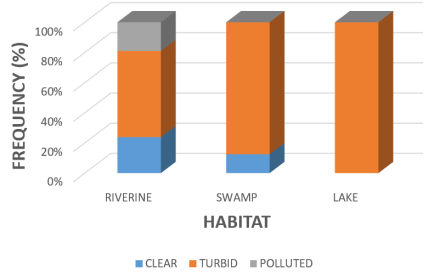
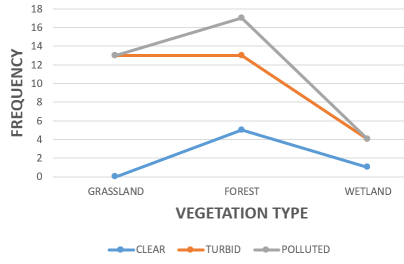
Figure 4. River-water Quality and Type of Habitat.
The river-water physical quality showed a significant association on vegetation type X
2 = 5.405 df=4 P<0.05 (
Figure 4). Vegetation plays a critical role in the health of aquatic ecosystems, influencing water quality and, consequently, the behavior and activity of species such as the hippopotamus (
Hippopotamus amphibius). In Mbam et Djerem National Park, the interaction between vegetation types and river water quality is essential for understanding how these factors affect hippopotamus populations. This literature review examines the influence of different vegetation types on river water quality and the subsequent effects on hippopotamus activity. Riparian zones, characterized by vegetation alongside riverbanks, serve as critical buffers that stabilize soils, reduce erosion, and filter pollutants from surface runoff
| [26] | Naiman, R. J., & Decamps, H. (1997). The ecology of interfaces: Riparian zones. Annual Review of Ecology and Systematics, 28, 621-658. |
[26]
. Riparian vegetation can absorb excess nutrients from agricultural runoff, such as nitrates and phosphates, thereby reducing nutrient loading in rivers
| [21] | Lowrance, R., Hendrickson, O. Q., & Williams, R. (1997). Riparian forest ecosystem and the role of vegetation in the management of water quality. Ecological Applications, 7(4), 1299-1314. |
[21]
. Trees and shrubs provide shade, which helps regulate water temperature and maintain dissolved oxygen levels, critical for aquatic life
| [31] | Stommel, C., Hofer, H., & East, M. (2016). The effect of reduced water availability in the Great Ruaha River on the vulnerable common hippopotamus in the Ruaha National Park, Tanzania. PLoS ONE, 11(6), e0157145. |
[31]
. The presence of lush aquatic and riparian vegetation positively correlates with hippopotamus foraging success. Areas with diverse plant species provide more food options, influencing the duration and frequency of foraging activities
| [23] | McDonald, K. (2022). Pilot study and ethogram development with a common hippo pod at West Midland Safari Park. ResearchGate. |
[23]
. Different vegetation types vary in nutritional content, impacting the health and energy levels of hippopotamuses. High-quality forage can lead to increased foraging time and social interactions among individuals
| [32] | Tefera, G. G., Tessema, T. H., Bekere, T. A., & Gutema, T. M. (2025). Feeding ecology and activity patterns of Hippopotamus amphibius in the Dhidhessa Wildlife Sanctuary, Southwestern Ethiopia. PLoS One, 20(8), e0325731. |
[32]
.
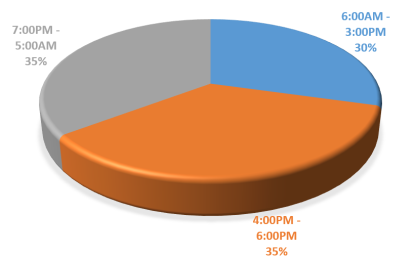
Different day periods recorded 35% for morning and afternoon periods and 30% for evening period respectively (
Figure 5). Hippopotamuses exhibit distinct daily activity patterns, with 35% of their time spent active during the morning and afternoon and 30% during the evening. These patterns are primarily driven by feeding behaviors, social interactions, and territorial dynamics. Understanding the implications of these activity distributions is essential for effective conservation strategies aimed at protecting both hippopotamus populations and their habitats. During the morning and early afternoon, hippopotamuses engage in significant feeding activities. They typically emerge from water bodies to graze on grasses and other vegetation, taking advantage of cooler temperatures before the heat of the day sets in
| [31] | Stommel, C., Hofer, H., & East, M. (2016). The effect of reduced water availability in the Great Ruaha River on the vulnerable common hippopotamus in the Ruaha National Park, Tanzania. PLoS ONE, 11(6), e0157145. |
[31]
. Morning hours often see increased social interactions among hippopotamus pods. As they forage, they engage in grooming behaviors and social displays that help maintain group cohesion and hierarchy
| [23] | McDonald, K. (2022). Pilot study and ethogram development with a common hippo pod at West Midland Safari Park. ResearchGate. |
[23]
. Males may also exhibit territorial behavior during this time, especially in areas where food resources are abundant. This can lead to increased aggression as they establish dominance over feeding grounds
| [34] | Vale, D. P., Coulibaly, M., Diarrassouba, A., Paris, M., & Kone, I. (2024). Influence of Water Quality On The Distribution of Pygmy Hippopotamus (Choeropsis liberiense, Morton 1849) in Taï National Park in Côte D'ivoire. Scribd. |
[34]
. The evening period marks a shift in activity as hippos prepare for nocturnal foraging. They are most active during this time, utilizing cooler temperatures to graze extensively on terrestrial vegetation
| [32] | Tefera, G. G., Tessema, T. H., Bekere, T. A., & Gutema, T. M. (2025). Feeding ecology and activity patterns of Hippopotamus amphibius in the Dhidhessa Wildlife Sanctuary, Southwestern Ethiopia. PLoS One, 20(8), e0325731. |
[32]
.
Figure 6. Vegetation Type.
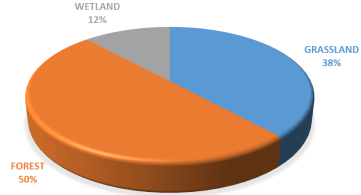
The vegetation types recorded were 50% forest, 38% grassland, and 12% wetland respectively (
Figure 6). Forests (50%), grasslands (38%), and wetlands (12%) each play vital roles in maintaining ecological balance and supporting biodiversity. Their unique characteristics and functions highlight the need for comprehensive conservation strategies that address the specific challenges faced by each vegetation type. Continued research and management efforts are essential for preserving these critical ecosystems and the diverse species that depend on them. Forests are characterized by a dense canopy of trees, which can vary significantly based on geographic location, climate, and soil type. They are rich in biodiversity, providing habitat for a wide range of flora and fauna. Forests host a vast array of species, including trees, shrubs, and understory plants. The complexity of forest structures supports numerous animal species, from insects to large mammals
| [26] | Naiman, R. J., & Decamps, H. (1997). The ecology of interfaces: Riparian zones. Annual Review of Ecology and Systematics, 28, 621-658. |
[26]
. Forests play a vital role in carbon storage, absorbing CO
2 from the atmosphere and helping mitigate climate change
| [27] | Pan, Y., et al. (2011). "A Large and Persistent Carbon Sink in the World's Forests." Science, 333(6045), 988-993. |
[27]
.
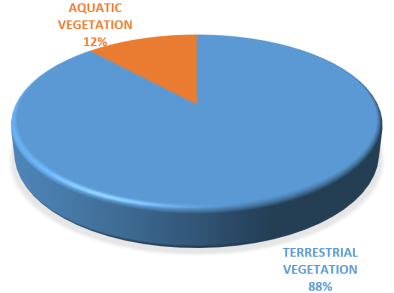
Hippopotamus terrestrial vegetation food resource 88% and aquatic vegetation is 12% (
Figure 7). Hippopotamuses (
Hippopotamus amphibius) are predominantly herbivorous mammals that rely on a diverse range of vegetation for their nutritional needs. In ecosystems like Mbam et Djerem National Park, the distribution and availability of terrestrial (88%) and aquatic (12%) vegetation significantly influence their behavior, including foraging habits, social dynamics, and overall health. The predominance of terrestrial vegetation (88%) over aquatic vegetation (12%) significantly influences the behavior of hippopotamuses in riverine ecosystems. By shaping foraging patterns, social interactions, and health, these food resources are critical for the survival and reproductive success of this species. Hippopotamuses are primarily nocturnal grazers, foraging for terrestrial vegetation at night. The abundance of terrestrial food resources (88%) allows them to cover significant distances in search of quality forage, impacting their daily activity patterns
| [23] | McDonald, K. (2022). Pilot study and ethogram development with a common hippo pod at West Midland Safari Park. ResearchGate. |
[23]
. Hippos exhibit selective feeding behaviors, preferring tender parts of plants. The availability of diverse terrestrial vegetation encourages this selective foraging, ensuring they meet their nutritional requirements
| [31] | Stommel, C., Hofer, H., & East, M. (2016). The effect of reduced water availability in the Great Ruaha River on the vulnerable common hippopotamus in the Ruaha National Park, Tanzania. PLoS ONE, 11(6), e0157145. |
[31]
. The majority of feeding occurs in areas with dense terrestrial vegetation, which not only provides food but also cover from predators. In contrast, aquatic plants are often a supplementary resource, utilized when terrestrial options are scarce
| [34] | Vale, D. P., Coulibaly, M., Diarrassouba, A., Paris, M., & Kone, I. (2024). Influence of Water Quality On The Distribution of Pygmy Hippopotamus (Choeropsis liberiense, Morton 1849) in Taï National Park in Côte D'ivoire. Scribd. |
[34]
(Vale et al., 2024).
Figure 8. River-water quality and Behavior of Hippopotamus.
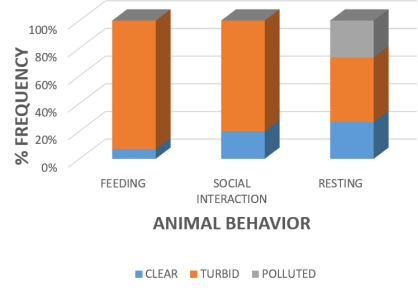
There was a significant link between river-water quality and animal behavior X
2=8.912 df=4 P<0.05 (
Figure 8). The quality of river water significantly influences the behavior of hippopotamuses, impacting their foraging habits, social interactions, and overall health. Pollution in river systems poses a serious threat to the survival of this iconic species. Effective conservation strategies must prioritize water quality management to ensure the sustainability of hippopotamus populations and the ecosystems they inhabit. Hippopotamuses (
Hippopotamus amphibius) are large semi-aquatic mammals that inhabit rivers and lakes across sub-Saharan Africa. They rely heavily on freshwater ecosystems for their survival, making them particularly vulnerable to changes in river water quality. Polluted waters often harbor pathogens and parasites that can affect the health of hippopotamuses. The introduction of these harmful microorganisms can lead to increased disease susceptibility, which can disrupt social structures and feeding behaviors
| [28] | Rojas, C., et al. (2012). "Environmental Pollution and Its Effects on Animal Health." Veterinary Clinics of North America: Small Animal Practice, 42(6), 1123-1134. |
[28]
. Increased sedimentation from soil erosion and runoff can lead to turbid water conditions, impacting visibility and food availability for hippos.
Figure 9. River-water Quality and Vegetation.
Vegetation type related significantly with water quality X
2=10.688 df=4 P=0.030 (
Figure 9). The interplay between river water quality and vegetation type significantly influences the behavior and health of hippopotamuses. Maintaining high water quality and diverse, healthy vegetation is essential for supporting hippopotamus populations and ensuring the sustainability of riverine ecosystems. Effective conservation strategies must address these interconnected factors to protect this iconic species and its habitat. The types of vegetation in riverine ecosystems, such as aquatic plants, grasses, and shrubs, play a significant role in supporting hippopotamus populations. The availability and quality of these plants directly influence their foraging habits. Hippopotamuses rely on a variety of aquatic plants, including reeds, sedges, and submerged vegetation, for sustenance. The health of these plant communities is closely tied to water quality, as polluted waters can diminish plant growth and diversity
| [31] | Stommel, C., Hofer, H., & East, M. (2016). The effect of reduced water availability in the Great Ruaha River on the vulnerable common hippopotamus in the Ruaha National Park, Tanzania. PLoS ONE, 11(6), e0157145. |
[31]
. In addition to aquatic plants, hippos graze on grasses and shrubs in surrounding areas. The quality and availability of terrestrial vegetation can be affected by water quality, particularly in floodplain ecosystems where nutrient runoff can enhance or degrade plant growth
| [23] | McDonald, K. (2022). Pilot study and ethogram development with a common hippo pod at West Midland Safari Park. ResearchGate. |
[23]
. High water quality supports robust aquatic plant growth, providing ample food sources for hippos. Conversely, poor water quality can lead to reduced vegetation availability, forcing hippos to travel further and expend more energy in search of food
| [32] | Tefera, G. G., Tessema, T. H., Bekere, T. A., & Gutema, T. M. (2025). Feeding ecology and activity patterns of Hippopotamus amphibius in the Dhidhessa Wildlife Sanctuary, Southwestern Ethiopia. PLoS One, 20(8), e0325731. |
[32]
. Changes in water quality can also lead to shifts in diet composition. For example, when preferred aquatic plants are scarce due to pollution, hippos may be forced to consume less nutritious or less palatable vegetation, potentially affecting their health and reproductive success
| [34] | Vale, D. P., Coulibaly, M., Diarrassouba, A., Paris, M., & Kone, I. (2024). Influence of Water Quality On The Distribution of Pygmy Hippopotamus (Choeropsis liberiense, Morton 1849) in Taï National Park in Côte D'ivoire. Scribd. |
[34]
. In areas where vegetation is limited due to poor water quality, competition for food can increase, leading to aggressive interactions among individuals. This can disrupt social hierarchies and negatively impact breeding success
| [23] | McDonald, K. (2022). Pilot study and ethogram development with a common hippo pod at West Midland Safari Park. ResearchGate. |
[23]
.
4. Discussion
Hippopotamuses (
Hippopotamus amphibius) are primarily aquatic mammals that rely heavily on riverine ecosystems for their survival. As such, they are particularly vulnerable to the impacts of river water pollution. This literature review examines how different types of pollution, chemical, biological, and physical, affect the behavioral activities of hippopotamuses, including foraging, social interactions, and overall health. Runoff from agricultural activities often leads to nutrient pollution, particularly nitrogen and phosphorus. This can result in algal blooms, which reduce water quality and deplete oxygen levels, adversely affecting the aquatic ecosystem
| [30] | Smith, V. H., et al. (1999). "Eutrophication Science: The Role of Nitrogen and Phosphorus." Environmental Science & Technology, 33(12), 1742-1747. |
[30]
. Industrial discharges introduce heavy metals (e.g. mercury, lead) and other toxins into river systems, which can accumulate in the tissues of aquatic organisms and subsequently affect the health of hippos that consume contaminated vegetation or water. Pollution can introduce pathogens and parasites into river systems, which not only affect the health of hippopotamuses but also disrupt their social dynamics and behavior
| [28] | Rojas, C., et al. (2012). "Environmental Pollution and Its Effects on Animal Health." Veterinary Clinics of North America: Small Animal Practice, 42(6), 1123-1134. |
[28]
. Polluted waters may favor the proliferation of invasive species that can outcompete native flora and fauna, disrupting the ecological balance of the habitat
| [36] | Vitousek, P., et al. (1996). "Biological Invasions as Global Environmental Change." American Scientist, 84(5), 468-478. |
[36]
. Increased sedimentation from erosion due to land use changes can lead to turbidity in water, affecting visibility and food availability for hippopotamuses. Sediment can smother aquatic vegetation, reducing the food supply
| [7] | Dudgeon, D. (2000). "Tropical Asian Streams: Zoobenthic Biodiversity and Conservation." Aquatic Conservation: Marine and Freshwater Ecosystems, 10(4), 249-263. |
[7]
. Urban runoff and improper waste disposal can introduce solid waste and debris into river systems, further degrading habitat quality and impacting hippo behavior. Chemical pollution, particularly nutrient enrichment, can lead to harmful algal blooms that reduce the availability of aquatic vegetation. Hippos rely on both aquatic and terrestrial plants for nutrition, and reduced food sources can force them to expend more energy searching for adequate forage
| [31] | Stommel, C., Hofer, H., & East, M. (2016). The effect of reduced water availability in the Great Ruaha River on the vulnerable common hippopotamus in the Ruaha National Park, Tanzania. PLoS ONE, 11(6), e0157145. |
[31]
. Polluted waters may lead hippos to alter their foraging preferences, potentially moving to less polluted areas or changing their diet to include less desirable vegetation, which may not provide adequate nutrition
| [23] | McDonald, K. (2022). Pilot study and ethogram development with a common hippo pod at West Midland Safari Park. ResearchGate. |
[23]
.
As other herbivores take refuge from heat, hippos can exploit feeding grounds with less competition, allowing them to consume larger quantities of vegetation
| [31] | Stommel, C., Hofer, H., & East, M. (2016). The effect of reduced water availability in the Great Ruaha River on the vulnerable common hippopotamus in the Ruaha National Park, Tanzania. PLoS ONE, 11(6), e0157145. |
[31]
. Evening gatherings provide opportunities for social bonding and reinforcement of social hierarchies within pods. Hippos may engage in synchronized movements as they move towards feeding areas, further enhancing group cohesion
| [23] | McDonald, K. (2022). Pilot study and ethogram development with a common hippo pod at West Midland Safari Park. ResearchGate. |
[23]
. The distribution of activity periods impacts the feeding efficiency of hippopotamuses. By foraging during cooler parts of the day, they minimize energy expenditure and reduce the risk of overheating, which is critical given their large size and thick skin
| [34] | Vale, D. P., Coulibaly, M., Diarrassouba, A., Paris, M., & Kone, I. (2024). Influence of Water Quality On The Distribution of Pygmy Hippopotamus (Choeropsis liberiense, Morton 1849) in Taï National Park in Côte D'ivoire. Scribd. |
[34]
. Access to quality forage during specific times of the day can significantly affect the health and nutritional status of hippopotamus populations. Effective feeding strategies during morning and evening hours ensure optimal energy intake, which is essential for reproduction and overall well-being
| [32] | Tefera, G. G., Tessema, T. H., Bekere, T. A., & Gutema, T. M. (2025). Feeding ecology and activity patterns of Hippopotamus amphibius in the Dhidhessa Wildlife Sanctuary, Southwestern Ethiopia. PLoS One, 20(8), e0325731. |
[32]
. Understanding the daily activity patterns of hippopotamuses is vital for conservation strategies. Habitat management efforts should consider the timing of hippopotamus activities to minimize human-wildlife conflict, particularly in areas where agricultural encroachment occurs. Conservation efforts should prioritize the protection of key feeding areas and water sources to support the natural behavior of hippopotamuses, especially during peak activity periods
| [23] | McDonald, K. (2022). Pilot study and ethogram development with a common hippo pod at West Midland Safari Park. ResearchGate. |
[23]
.
Forests contribute to the hydrological cycle by enhancing groundwater recharge, maintaining stream flows, and reducing soil erosion through root structures
| [11] | Gibbons, P., et al. (2010). "Mapping the World’s Forests: A New Global Forest Map from Satellite Imagery." Global Change Biology, 16(1), 1-3. |
[11]
. Grasslands are dominated by grasses and herbaceous plants, with few trees or shrubs. They typically occur in regions with moderate to low rainfall and are often maintained by periodic disturbances such as fire or grazing. Grasslands can be categorized into various types, including prairies, savannas, and steppes, each with unique species compositions and environmental conditions
| [18] | Knapp, A. K., et al. (2018). "Grassland Ecology: A Brief Overview." Ecology, 99(1), 1-12. |
[18]
. Wetlands are transitional zones between terrestrial and aquatic ecosystems, characterized by saturated soils and the presence of water-loving vegetation, such as reeds and sedges. Wetlands can be classified into various categories, including marshes, swamps, and bogs, each with distinct hydrological and ecological features
| [24] | Mitsch, W. J., & Gosselink, J. G. (2015). Wetlands. John Wiley & Sons. |
[24]
. Wetlands play a crucial role in filtering pollutants and sediments from water, improving overall water quality in adjacent ecosystems
| [37] | Zedler, J. B., & Kercher, S. (2005). "Wetland Resources: Status, Trends, Ecosystem Services, and Restoration." Annual Review of Environment and Resources, 30, 39-74. |
[37]
. Wetlands act as natural buffers, absorbing excess rainfall and reducing the risk of flooding in surrounding areas
| [24] | Mitsch, W. J., & Gosselink, J. G. (2015). Wetlands. John Wiley & Sons. |
[24]
. Wetlands provide critical habitats for a variety of aquatic and semi-aquatic species, including fish, amphibians, and migratory birds. These areas are often biodiversity hotspots
| [16] | Keddy, P. A. (2010). Wetland Ecology: Principles and Conservation. Cambridge University Press. |
[16]
. Many species rely on wetlands as breeding grounds, emphasizing their importance in maintaining healthy populations of aquatic organisms
| [37] | Zedler, J. B., & Kercher, S. (2005). "Wetland Resources: Status, Trends, Ecosystem Services, and Restoration." Annual Review of Environment and Resources, 30, 39-74. |
[37]
. Conservation efforts should adopt an integrated approach that recognizes the interconnectedness of these ecosystems and their roles in supporting biodiversity and ecosystem services. Protecting and restoring degraded habitats across all three vegetation types is crucial for enhancing ecological resilience and supporting wildlife populations.
The smothering of aquatic vegetation reduces the quality of forage available in their habitats
| [7] | Dudgeon, D. (2000). "Tropical Asian Streams: Zoobenthic Biodiversity and Conservation." Aquatic Conservation: Marine and Freshwater Ecosystems, 10(4), 249-263. |
[7]
(Dudgeon, 2000). Turbidity can hinder foraging efficiency, forcing hippos to expend more energy searching for food. This can lead to behavioral changes, such as increased nocturnal foraging to avoid competition with other herbivores
| [31] | Stommel, C., Hofer, H., & East, M. (2016). The effect of reduced water availability in the Great Ruaha River on the vulnerable common hippopotamus in the Ruaha National Park, Tanzania. PLoS ONE, 11(6), e0157145. |
[31]
. Water temperature and flow rates can also influence hippopotamus behavior. Pollutants can alter the thermal properties of water, which can affect the distribution of aquatic vegetation and the overall health of the ecosystem
| [26] | Naiman, R. J., & Decamps, H. (1997). The ecology of interfaces: Riparian zones. Annual Review of Ecology and Systematics, 28, 621-658. |
[26]
. Water quality directly affects the foraging patterns of hippopotamuses. Poor water quality can force hippos to alter their feeding strategies, leading to increased foraging distances and changes in diet composition. This behavior can result in energy deficits, affecting their overall health and reproductive success
| [23] | McDonald, K. (2022). Pilot study and ethogram development with a common hippo pod at West Midland Safari Park. ResearchGate. |
[23]
. The social dynamics of hippopotamus pods are closely linked to environmental conditions. Increased competition for food due to diminished vegetation can lead to heightened aggression and territorial disputes among group members, disrupting social structures and leading to stress
| [32] | Tefera, G. G., Tessema, T. H., Bekere, T. A., & Gutema, T. M. (2025). Feeding ecology and activity patterns of Hippopotamus amphibius in the Dhidhessa Wildlife Sanctuary, Southwestern Ethiopia. PLoS One, 20(8), e0325731. |
[32]
. Poor water quality significantly impacts the health of hippopotamuses, affecting their reproductive capabilities. Stress induced by environmental changes can lead to hormonal imbalances and lower reproductive rates, which can have long-term consequences for population sustainability.
In areas with abundant terrestrial vegetation, social hierarchies tend to be more stable, as food is plentiful. However, during periods of food scarcity, competition may increase, leading to heightened aggression and altered social dynamics
| [32] | Tefera, G. G., Tessema, T. H., Bekere, T. A., & Gutema, T. M. (2025). Feeding ecology and activity patterns of Hippopotamus amphibius in the Dhidhessa Wildlife Sanctuary, Southwestern Ethiopia. PLoS One, 20(8), e0325731. |
[32]
. In favorable feeding conditions, hippos may exhibit cooperative behaviors, such as foraging in groups and increased social interactions, which can enhance group cohesion and reproductive success
| [23] | McDonald, K. (2022). Pilot study and ethogram development with a common hippo pod at West Midland Safari Park. ResearchGate. |
[23]
. The availability of high-quality terrestrial food resources positively influences maternal care and calf survival. Mothers with access to abundant nutrition are better able to rear healthy calves, which is essential for the population's sustainability
| [31] | Stommel, C., Hofer, H., & East, M. (2016). The effect of reduced water availability in the Great Ruaha River on the vulnerable common hippopotamus in the Ruaha National Park, Tanzania. PLoS ONE, 11(6), e0157145. |
[31]
. Terrestrial vegetation generally offers higher nutritional value compared to aquatic plants. Access to diverse and high-quality forage can reduce the risk of malnutrition and enhance overall health, reproductive success, and longevity
| [34] | Vale, D. P., Coulibaly, M., Diarrassouba, A., Paris, M., & Kone, I. (2024). Influence of Water Quality On The Distribution of Pygmy Hippopotamus (Choeropsis liberiense, Morton 1849) in Taï National Park in Côte D'ivoire. Scribd. |
[34]
.
Pollution can lead to stress and health issues among hippopotamuses, potentially increasing aggressive interactions within pods. This can disrupt social hierarchies and affect reproductive success
| [34] | Vale, D. P., Coulibaly, M., Diarrassouba, A., Paris, M., & Kone, I. (2024). Influence of Water Quality On The Distribution of Pygmy Hippopotamus (Choeropsis liberiense, Morton 1849) in Taï National Park in Côte D'ivoire. Scribd. |
[34]
. The introduction of pathogens can compromise individual health and lead to increased mortality, further affecting social dynamics within groups
| [28] | Rojas, C., et al. (2012). "Environmental Pollution and Its Effects on Animal Health." Veterinary Clinics of North America: Small Animal Practice, 42(6), 1123-1134. |
[28]
. Polluted waters can increase the prevalence of diseases and parasites, compromising the health of hippos and reducing their reproductive success. Health issues can lead to lower calf survival rates, negatively impacting population dynamics. Exposure to pollutants can induce stress responses in hippos, which can alter their normal behaviors, such as feeding and socializing. Chronic stress may lead to long-term health issues, including hormonal imbalances and reproductive challenges
| [23] | McDonald, K. (2022). Pilot study and ethogram development with a common hippo pod at West Midland Safari Park. ResearchGate. |
[23]
. Regular assessment of water quality in habitats inhabited by hippopotamuses is essential for early detection of pollution and its impacts. Monitoring can help identify pollution sources and inform management practices
| [7] | Dudgeon, D. (2000). "Tropical Asian Streams: Zoobenthic Biodiversity and Conservation." Aquatic Conservation: Marine and Freshwater Ecosystems, 10(4), 249-263. |
[7]
. Conservation efforts should focus on restoring polluted river ecosystems to improve water quality and, by extension, the health and behavior of hippos. This includes controlling runoff and reducing industrial discharges into river systems. Raising awareness about the impacts of pollution on wildlife, including hippos, can foster community involvement in conservation efforts and promote sustainable practices. River water pollution significantly impacts the behavioral activities of hippopotamuses, affecting their foraging patterns, social interactions, and overall health. By understanding these impacts, conservationists and managers can implement effective strategies to protect both hippopotamus populations and the integrity of their aquatic habitats. Understanding the influence of water quality on hippopotamus activity is crucial for conservation efforts in Mbam et Djerem National Park. Poor water quality can lead to habitat degradation and reduced food availability, ultimately threatening the health and survival of hippopotamus populations
| [10] | Fotso, R. C. (2000). Assessment of the Ecological and Socio-Economic Importance of the Mbam and Djerem National Park, Cameroon. Thesis, University of Yaoundé I, Cameroon. |
[10]
. Effective management strategies must consider water quality monitoring and pollution control to ensure the sustainability of hippopotamus habitats.

 ,
Fominka Tajoacha Nestor
,
Fominka Tajoacha Nestor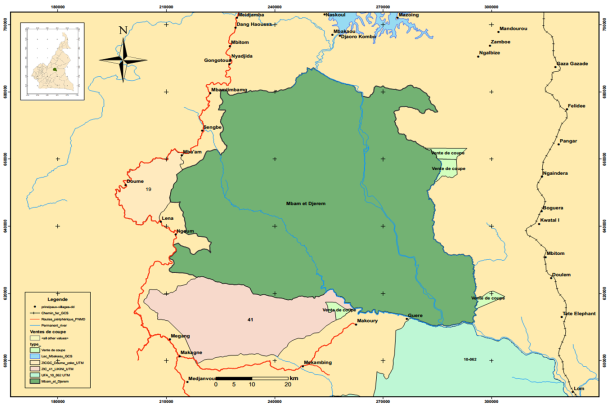



 Share This Article
 Twitter
 Linked In
 Facebook
 Copy
Copy Download